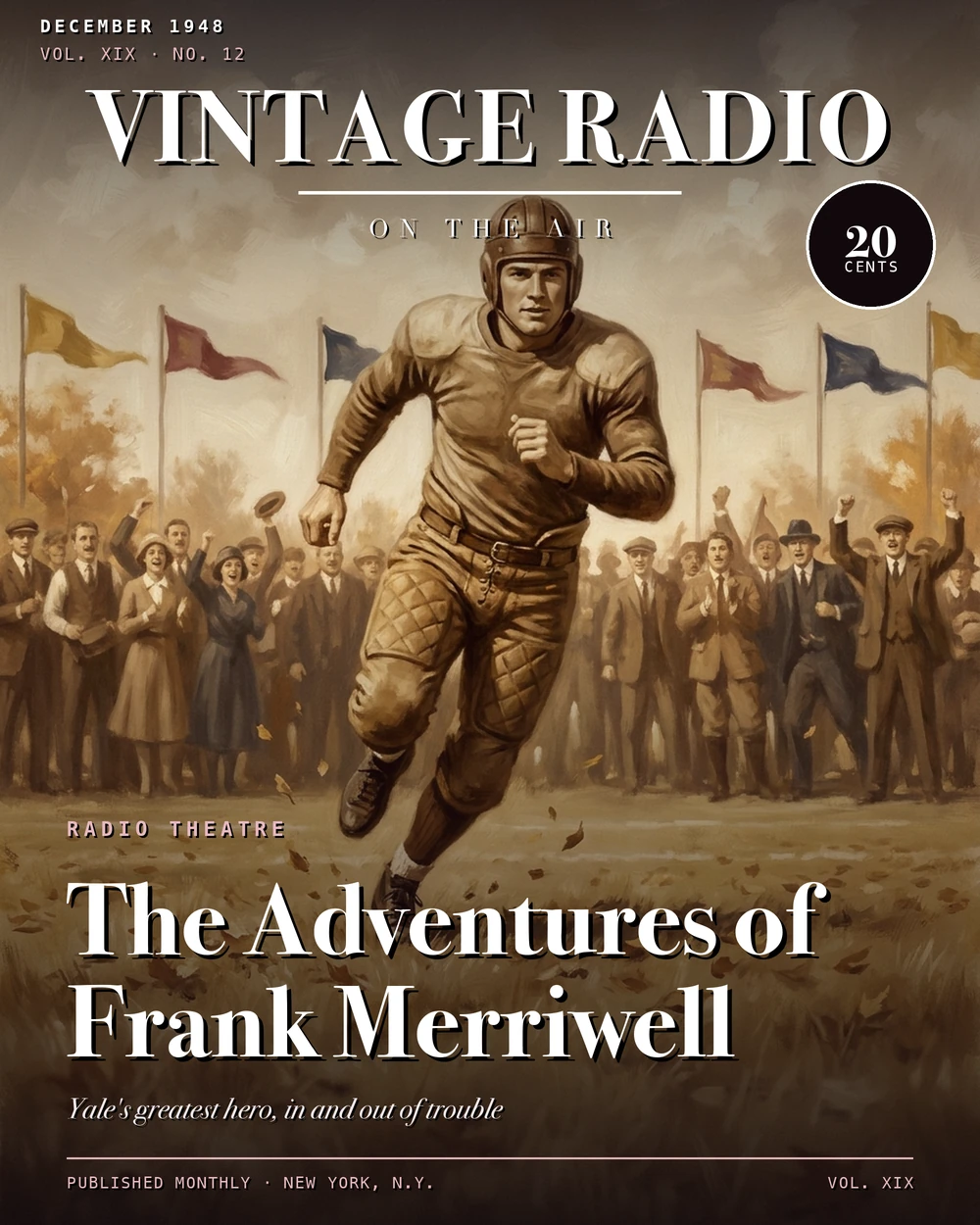
The Adventures of Frank Merriwell
The Character Behind the Show
Frank Merriwell was already a legend before radio ever found him. Gilbert Patten — writing as Burt L. Standish — first introduced the character in the April 18, 1896 issue of Tip Top Weekly in a story called "Frank Merriwell: or, First Days at Fardale," and he kept writing the stories at a pace of roughly twenty thousand words a week for close to twenty years. At the peak, Tip Top Weekly was selling around 135,000 copies a week. By the time NBC brought Merriwell to radio in 1934, the dime novel hero had been an American fixture for nearly four decades.
Patten's concept for his hero was as deliberate as it was simple. He explained the name this way: "Frank for frankness, merry for a happy disposition, well for health and abounding vitality." The character he built around that name was a super-athlete at turn-of-the-century Yale who excelled at football, baseball, basketball, crew, and track — an ideal of wholesome, vigorous American boyhood that had no serious rival in juvenile fiction of the era. Historians of sports literature have called Merriwell the model for all later American juvenile sports fiction, and the influence could be concrete and personal: Olympic champion boxer and bobsledder Eddie Eagan wrote in his autobiography, "To this day I have never used tobacco, because Frank Merriwell didn't."
Patten never profited from the phenomenon he created. Street & Smith owned the Merriwell property outright, and Patten was paid as a work-for-hire writer — up to $150 per story — with no royalties on any of the more than three hundred dime novels in the series. Some of those, published between 1927 and 1930, were written by other authors still using his Burt L. Standish pen name. Late in his life, Patten faced homelessness and had to be helped by public donations, including one from Wendell Willkie. He died in Vista, California, on January 16, 1945, while the radio revival that would bring his character back to NBC was in preparation.
The First Run: NBC, 1934
The first radio series opened on March 26, 1934, sponsored by Dr. West's Toothpaste. It ran three times a week at 5:30 in 15-minute continuation-format installments, wrapping up on June 22 of the same year — a brief, contained run by any measure. Donald Briggs played Frank Merriwell, with Harlow Wilcox as announcer. Almost everything known about this version comes from a single scratchy disc, which gives the 1934 run an appropriately mysterious quality.
What survives suggests a Merriwell with some genuine roughness to him. The serialized plots drew Frank into a shameful poker game, and in a later episode he confessed to his enemy-turned-pal Bart Hodge an uncontrollable weakness for gambling. There were periodic, tearful references to Frank's "dear, sweet mother," from whom he had once stolen money to feed his habit. This was not the squeaky-clean schoolboy hero of the dime novels — or at least not entirely. The radio version seemed content to give Merriwell some shadows that Patten's stories generally kept out of view.
Briggs himself had an interesting trajectory out of the role. His performance caught the attention of film director Clifford Smith, who was reportedly struck by his "velvety baritone voice, slim physique, and dark good looks" and helped arrange a move to Los Angeles. The Frank Merriwell radio role led directly to Briggs being cast in the 1936 Universal 12-chapter film serial The Adventures of Frank Merriwell — his first film appearance. That serial, which updated the setting from the 1890s to contemporary 1936 and drew on multiple Standish stories, co-starred Jean Rogers — who had also played Dale Arden in Universal's Flash Gordon — as Elsie Belwood, with John "Dusty" King as Bruce Browning. The supporting cast featured the sons of several well-known film actors: House Peters Jr., Wallace Reid Jr., Edward Arnold Jr., and future glamour photographer Peter Gowland, among others. Beyond Merriwell, Briggs went on to play the title role in The First Nighter Program, The Sheriff, and Perry Mason on radio, and appeared in more than 75 films and television productions over a career that stretched into the 1970s.
The Second Run: 1946–1949
Twelve years after the first series ended, NBC revived Frank Merriwell on October 5, 1946, in a substantially different format. This version ran for half an hour every Saturday morning and aimed at something the continuation serial had not tried: a nostalgic, self-contained episode structure that treated each week as a complete story. The show opened with the sound of a trotting horse and a distinctive signature, and the opening narration reached directly for atmosphere — evoking "an echo of the past," horse-drawn carriages, gas-lit streets, and free-for-all football games. The 10 a.m. Saturday time slot, which held from 1946 through 1948 before shifting to various later Saturday times, placed it squarely in the children's programming hours.
Lawson Zerbe took over as Frank Merriwell for the revival. Born in Portland, Oregon, in 1914 and raised in Dayton, Ohio, Zerbe had built his radio foundation at a Dayton station before moving to Cincinnati's WLW in 1934 and eventually landing in New York. A May 1949 article in Radio Mirror described him as "the man of a thousand voices" who could "play two characters on the same program—switch flawlessly from one to the other without batting an eye." His broader radio credits ran to Inner Sanctum, Dimension X, X Minus One, Suspense, Cavalcade of America, Casey Crime Photographer, Gangbusters, Mysterious Traveler, and Yours Truly Johnny Dollar — about as full a résumé of dramatic radio as the era offered.
The supporting cast had its own complications. Elaine Rost — also credited in some sources as Elaine Rostas — and at a different point Jean Gillespie both played Frank's girlfriend Inza Burrage, indicating a recasting somewhere during the run. Hal Studer played Bart Hodge and Patricia Hosley played Elsie Bellwood, with Lamont Johnson, Brad Barker, and Grace Reddy rounding out the regulars. Harlow Wilcox, who had announced the 1934 series, returned alongside Mel Brandt. Music came from Paul Taubman, with multiple sources describing a full orchestra rather than the organ-only arrangement sometimes attributed to him. Directors across the run included Ed King, Joseph Mansfield, Harry Junkin, and Fred Weihe, with scripts by Ruth and Gilbert Brann and William Welch. The theme drew on Yale music — sources differ on whether that was "Boola Boola" or the alma mater "Bright College Years," and the show may well have used both at different points.
The Criticism and the Time Slot Problem
Not everyone was satisfied with what NBC had done with the Merriwell name. In September 1948, New York Times critic Jack Gould wrote that the second series did not bear "any reasonable resemblance to the original stories" and suggested the title "might mislead parents as to its wholesomeness." Gould pointed at a particular irony: NBC had, at that time, restricted crime program broadcasts to 9:30 p.m. or later because of the potential effect on young listeners. Yet Frank Merriwell — which Gould characterized as a "saga of assault, arson, larceny and horror" — was airing on Saturday mornings at 10 a.m. Within weeks of the review, the program was moved from that 10 a.m. slot to 12:30 p.m. Eastern. The second series ran until June 4, 1949, when it ended its NBC run for good.
The gap between the show's nostalgic presentation — the trotting horse, the gaslit streets, the wholesome Yale hero — and what Gould described as its actual content says something real about the distance between the character's origin and where radio drama had gone by the late 1940s. The revival was trying to sell two things at once: the warm, sepia-toned memory of Merriwell and the narrative urgency that kept Saturday-morning ears tuned in.
The Character's Longer Life
The Frank Merriwell property had a life well beyond radio. The original Tip Top Weekly run continued through 1912. A comic strip debuted on March 26, 1928, distributed by the McClure Newspaper Syndicate, written by Patten and illustrated by John Hix; it came back in July 1931 as Frank Merriwell's Schooldays, syndicated by the Central Press Association with illustrations by Jack Wilhelm, and ran through 1936. In 1965, author Mike Frederic launched a new book series, though only three volumes appeared: Frank Merriwell Returns, Frank Merriwell Quarterback, and Frank Merriwell At The Wheel in 1967. The character across Patten's fiction also extended across generations — Frank, his half-brother Dick Merriwell, and eventually Frank's son Frank Merriwell Jr. A Broadway musical, Frank Merriwell, or Honor Unchallenged, opened at the Longacre Theatre on April 24, 1971, and closed after one performance.
Academic attention came as well. Ryan K. Anderson's Frank Merriwell and the Fiction of All-American Boyhood: The Progressive Era Creation of the Schoolboy Sports Story, published by the University of Arkansas Press in 2015, placed the character in the context of progressive-era ideals about youth and masculinity. John L. Cutler's earlier study, Gilbert Patten and His Frank Merriwell Saga: A Study in Sub-Literary Fiction, 1896–1913, offered one of the first serious scholarly treatments of the source material. The New York Public Library for the Performing Arts holds a collection of 51 episodes from the second series' 1946–1947 season, catalogued at call number *L (Special) 98.15, most of them off-air recordings from WEAF or WNBC. The premiere episode from October 5, 1946, titled "Riddle of Wrong Answers," is among the known survivors.